How to Read Your Paint: Swirls, Oxidation, Etching and the Hand Test
Five minutes in the sun with your own hands will tell you what your paint needs.
October 16, 2026 · 4 min read
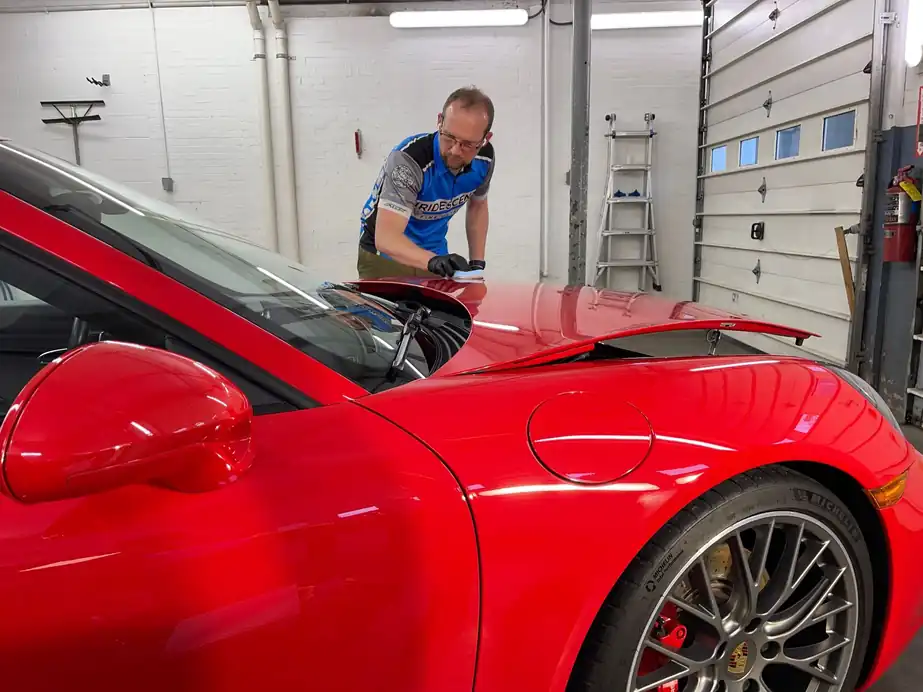
Most people can tell when a car looks dull. Fewer can say why. Paint problems come in a handful of types, each with its own look and its own fix, and you can sort most of them out yourself on a sunny afternoon in the driveway. Knowing what you're looking at makes any conversation with a detailer shorter and more useful, and it keeps you from paying for more correction than your paint needs.
Start with light
Paint hides its flaws indoors. Fluorescent garage lights and shade flatten everything. Pull the car into direct sun, or shine a bright flashlight across a panel from the side, and the story changes. Look at the hood and the driver's door first, then the roof. Dark colors show defects fastest, but every color has them.
Swirl marks
Swirls are the spider-web look: thousands of hairline scratches running in circles and arcs, most visible in direct sunlight. They're the most common paint complaint, and they mostly come from how a car gets washed. Automatic brushes, dry wiping, a dropped mitt reused without rinsing and rough towels all leave them behind. They don't hurt the paint's structure. They scatter light, which is why a swirled car looks hazy instead of deep.
Oxidation
Oxidation is what long sun exposure does to the top of the paint. The color fades, the gloss goes flat, and the finish stops looking wet. It starts on horizontal surfaces, the hood, roof and trunk, because that's where the sun hits hardest. If your hood looks a shade lighter or chalkier than your doors, you're probably looking at oxidation. A car that sits outside all day shows it sooner than one that lives in a garage.
Etching
Etching is damage from something sitting on the paint and eating into the clear coat. Bird droppings, tree sap and hard water spots are the usual culprits. You'll see dull patches, faint outlines where a drop dried, or a ring where water evaporated. Fresh deposits can often be wiped away. Ones that have been baked in by the sun can leave a mark that stays after the wash. The sooner you clean droppings and sap off, the better your odds.
The texture test
Sometimes your eyes can't tell, but your hand can. After a wash, run your fingertips lightly over the paint. A smooth, silky feel means a clean surface. A gritty or rough feel means contaminants have bonded to the paint, and washing alone won't pull them off. A popular shop trick makes this easier: slip your hand into a thin plastic sandwich bag and glide it over the panel. The bag amplifies what your fingers pick up, so even small bumps feel obvious.
Texture is a different problem from swirls. A rough panel needs decontamination before anything else, and it's the first step the shop does on every correction level, right after a two bucket hand wash.
What the three levels aim to fix
Once you know what you're seeing, the shop's three correction levels are easy to read. All prices are starting prices for a 2 Door Sport Coupe or Hatchback.
- Level 1 Enhancement Polish, from $475, about 3 to 4 days. Light machine polishing that aims to remove up to 20% of oxidation and light swirl marks. Deeper scratches and swirls may still be visible.
- Level 2 Correction, from $765, a minimum of 4 days. One step of polishing aimed at up to 50% of oxidation and light swirls.
- Level 3 Multi-Step Correction, from $1,240, about 4 to 5 days. Three steps of polishing, painted surfaces prepped, engine bay lightly cleaned, aimed at 90% or more of swirl marks and defects.
Notice the wording is "aim." Paint is a thin layer, and every car is different. A detailer can only take off so much clear coat safely, so the goal is to remove as much of the defect as the paint can give while leaving plenty behind. That's the reason a bright-light inspection is worth doing before you commit to a level.
Deeper scratches are the main limit. A good test is to drag a fingernail across a scratch. If your nail catches in it, the scratch has gone deeper than the clear coat in places, and polishing can soften it but may not erase it. That's worth hearing before the work starts, not after.
What to do after you know
If you found light swirls and a little haze, Level 1 or Level 2 may be all the paint needs. If the whole car looks like a spider web in the sun, Level 3 is where the shop aims for 90% or more. Every level includes an optional upgrade to wax, polymer sealant or ceramic coating, and the shop marks ceramic as highly recommended, since freshly corrected paint is the best surface a coating will ever get.
The shop's polishing training comes from the Big Foot Detailing Academy's Intensive Polishing Training Course, and the team is glad to look at your paint with you. Bring the car by 200 Greene Street, Suite B, at 2nd and Greene in downtown Marietta, or call (740) 525-0964. The shop will assess it and tell you whether correction makes sense for your circumstances.
Iridescent Fine Detailing, (740) 525-0964
Call (740) 525-0964More articles
Why Your Paint Needs Correcting Before a Ceramic Coating
A coating locks in the surface it's applied to, so the order of the work matters as much as the product.
Four Ceramic Coating Myths, Answered Plainly
Ceramic coating is good protection with real limits, and knowing the limits is how you keep it looking good.